









From Provision to Loss: Securing Asset Disposal under Microsoft Business Central
Index 
While the provision for doubtful accounts acts as a temporary shield, recognizing an irrecoverable loss is the final act of accounting clearance. It is the moment when uncertainty vanishes, replaced by a certainty: the debt will never be collected.
This transition cannot be arbitrary; it responds to strict legal criteria which, once met, finally allow for the recovery of VAT and the definitive closing of the file.
I. The Trigger: When does a loss become irrevocable?
One does not record a loss out of simple discouragement. For the tax administration to accept the final deduction of the charge and the recovery of VAT, the loss must be certain and definitive in nature.
1. Substantive conditions
Proof of uncollectibility generally relies on judicial liquidation (closure for insufficient assets), a formal notice of failed enforcement by a bailiff, or the proven disappearance of the debtor.
2. The certificate of uncollectibility
Although the accounting objective is universal—to faithfully reflect the loss in value of an asset—the procedures for recording a debt as a loss vary according to the legal and fiscal culture of each country. France stands out for its rigorous formalism where the "certificate of uncollectibility" often serves as the final proof to regularize VAT and taxes.
Conversely, Anglo-Saxon countries (USA and UK) favor an approach based on economic evidence.
- In the United States, the tax authorities do not require a specific form but demand that the company demonstrates the "worthlessness" of the debt. It is an accumulation of evidence (reminder emails, bankruptcy notification, reports from collection agencies) that justifies the write-off.
- In the United Kingdom, pragmatism prevails. To claim Bad Debt Relief (VAT recovery), the primary criterion is often temporal: a debt unpaid for more than six months and already removed from the accounts is generally sufficient to prove the loss, without mandatory intervention from a third party.
Italy, much like France, remains more attached to legal procedures. For significant debts, tax deduction is often suspended until the official closure of insolvency proceedings. However, it shows modern flexibility for small-amount debts, allowing their simplified deduction after a defined period of non-payment.
II. The Accounting Scheme: Final Settlement
Unlike the provision, recording a loss directly impacts revenue and allows for tax regularization.
1. The entry for loss recognition
The entry consists of recording the net loss and canceling the VAT-inclusive debt that appeared in the doubtful accounts:
- Debit the Loss Charge account: (FR: 654 / UK: 8100 / IT: 12.05.01) for the amount excluding tax.
- Debit the Collected VAT account (to be recovered): (FR: 4457 / UK: 2200 / IT: 05.01.01) for the tax portion.
- Credit the Doubtful Customer account: (FR: 416 / UK: 1101 / IT: 04.01.02) for the total VAT-inclusive amount.
2. Canceling the provision (The reversal)
Since the debt is removed from the assets, the previously established provision no longer has a purpose. It must be reversed to neutralize the impact on the result:
- Debit the Impairment account: (FR: 491 / UK: 1190 / IT: 04.01.09).
- Credit the Reversal account: (FR: 7817 / UK: 8150 / IT: 52.10.05).
III. The challenge of foreign currencies and VAT neutrality
When the uncollectible debt is denominated in a foreign currency, an additional layer of complexity arises. While the majority of international flows are tax-free (Reverse charge or Export), the issue of VAT in foreign currencies remains real for domestic sales in foreign currency or B2C services (OSS One-Stop Shop).
In these cases, Business Central calculates the loss at the daily rate to settle the customer account (FR: 416 / UK: 1101 / IT: 04.01.02), while generating an exchange difference (FR: 656/756 / UK: 8200 / IT: 14.20.01).
I will write an article on exchange rate revaluation in Business Central.
💡Fiscally, the recovery of VAT must remain based on the historical rate (that of the original invoice). The ERP must isolate the tax at the original rate to ensure that the State only refunds what was collected, without any exchange gain or loss on the tax.
IV. Implementation in Microsoft Business Central
1. Using the Payment Journal
Entry is generally done via a journal:
Account Type: Customer (select the doubtful customer's card).
Amount: The VAT-inclusive amount to be settled.
Bal. Account: The loss account (FR: 654 / UK: 8100 / IT: 12.05.01).
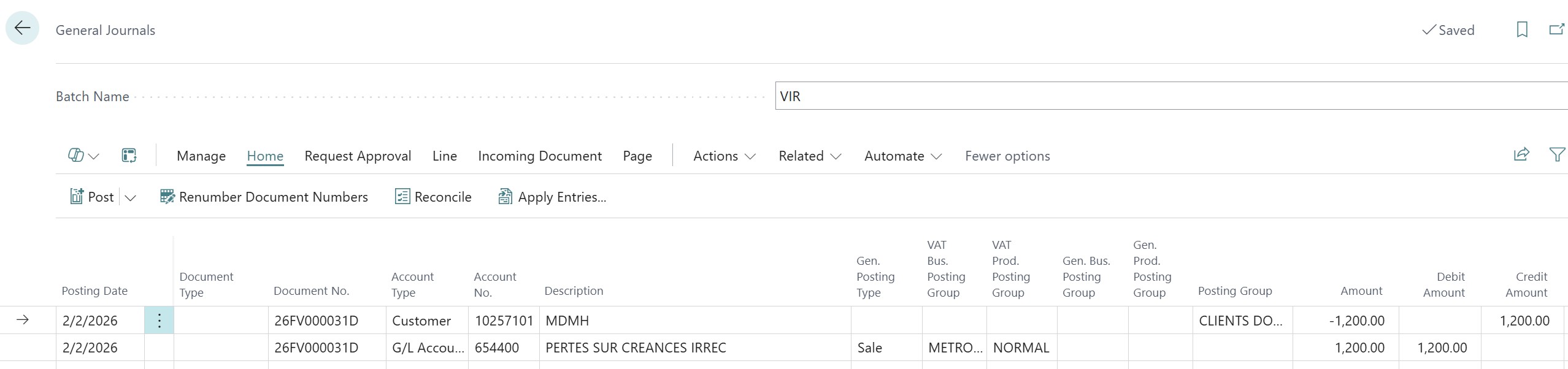
It is crucial to apply the loss entry to the doubtful debt entry (or the original invoice). This application "closes" the lifecycle of the debt and cleans up the aged trial balance.
When the debt is subject to cash accounting for VAT, recording it as a loss requires a regularization of the VAT that was never collected.
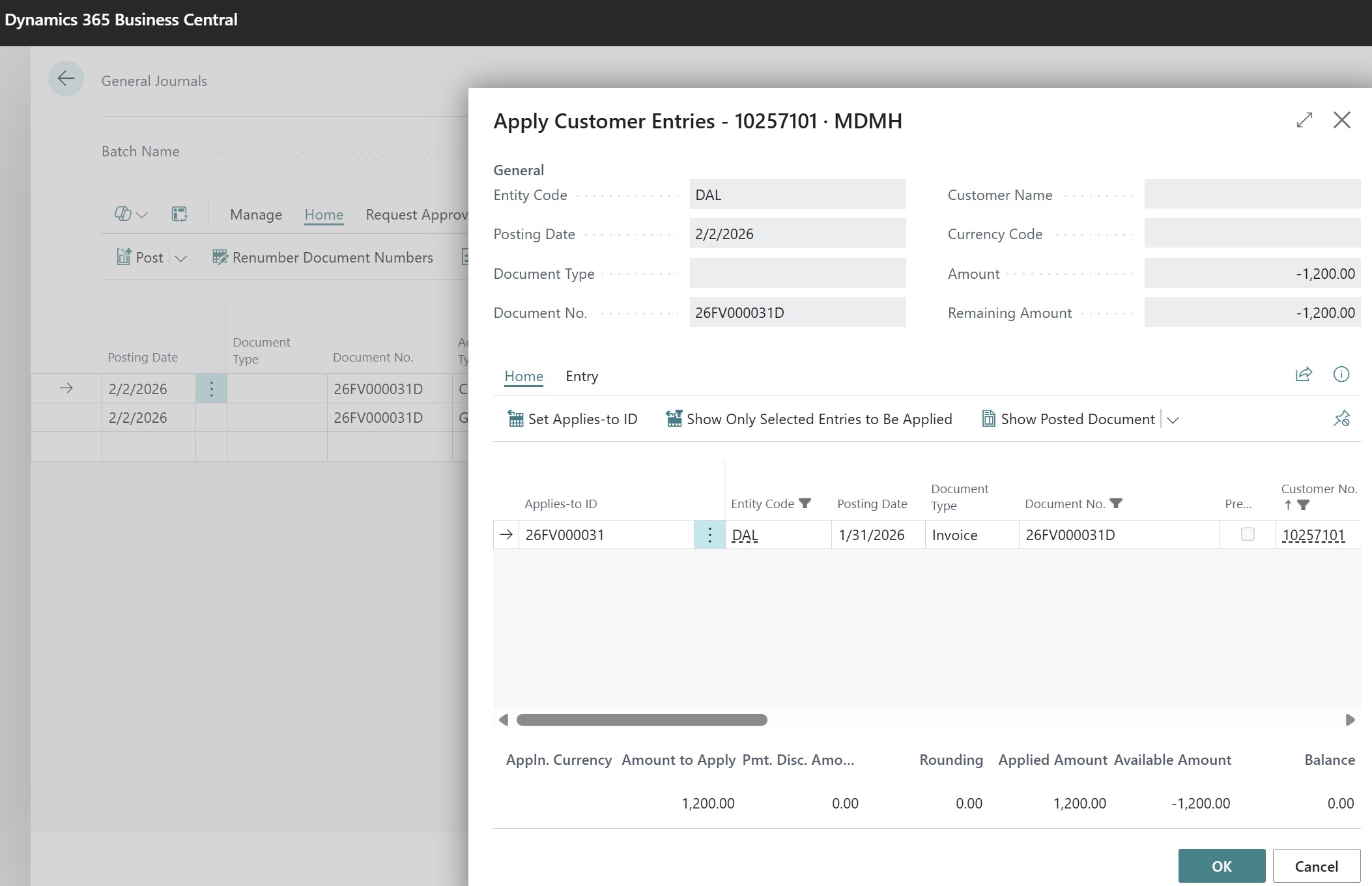
Furthermore, on the charge line (🇫🇷654 🇬🇧6330 🇮🇹65.10), you must specify:
This step cancels the potential VAT and ensures tax compliance.
2. The entries
Once the journal is posted, Business Central automatically generates the necessary entries to record the loss. This includes:
- The charge entry for the net loss (Excl. Tax).
- The regularization entry for the reversal of VAT which, under the cash VAT regime, will never be collected.
- The customer account balance entry (Incl. Tax) which definitively closes the uncollectible amount on the aged trial balance.
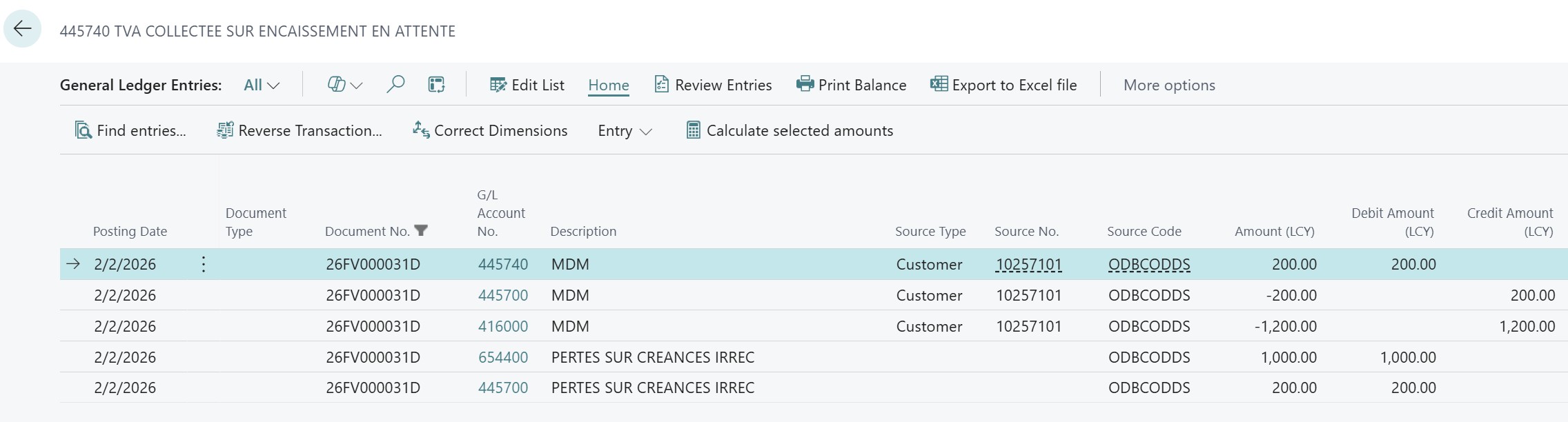
The customer ledger entries reflect the original invoice, the reversal, the move to doubtful debt, and the recognition of loss.
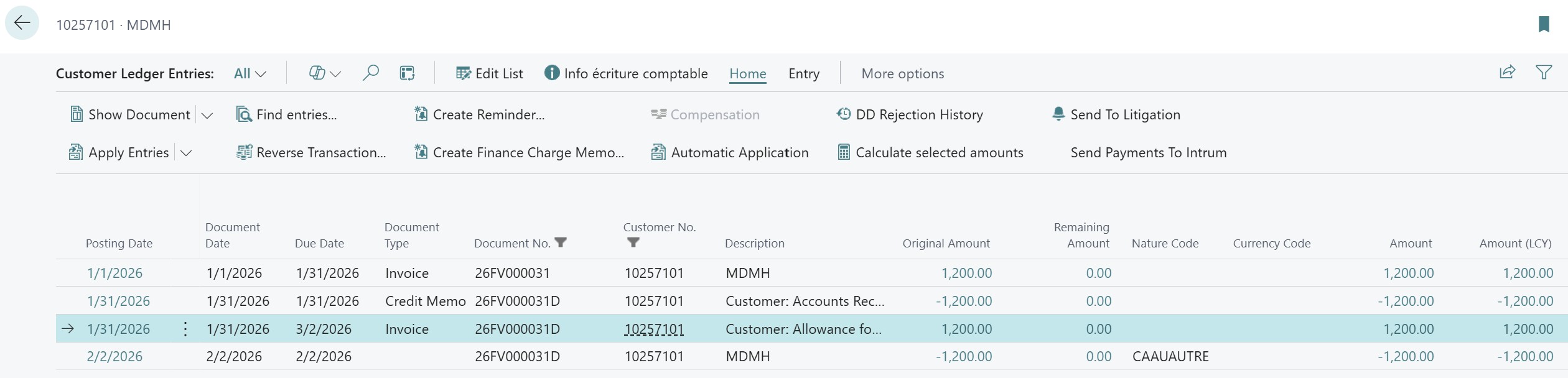
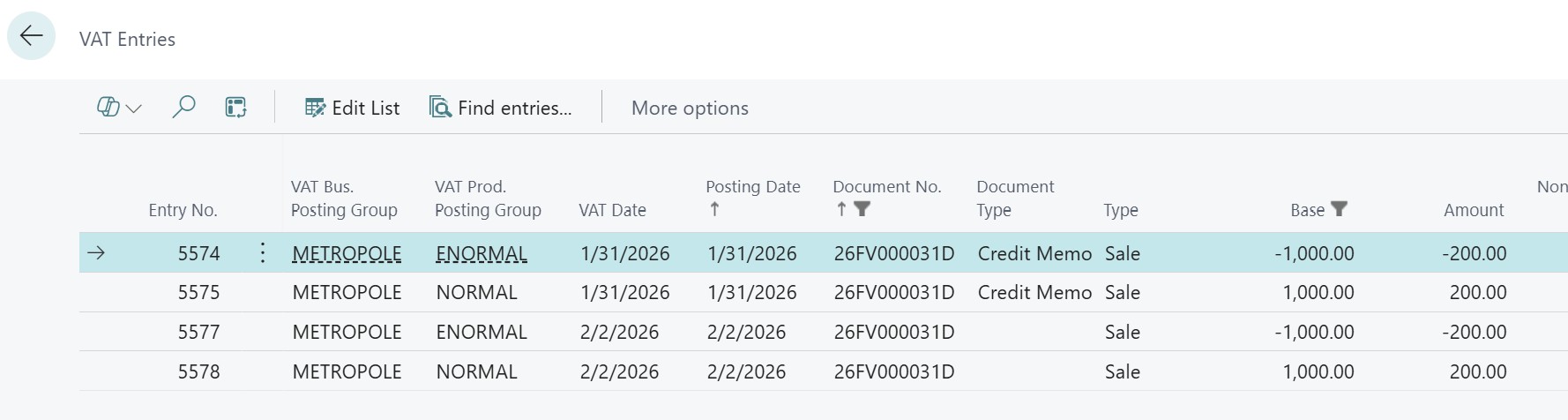
The VAT entries offset each other; although they must be declared, the accounting effect will be neutral.
V. Prevention and Risk Analysis: Acting Upstream with Business Central
Receivables management should not be limited to recording failures; it must prioritize anticipation. Microsoft Business Central natively offers monitoring tools to identify fragile accounts before they become critical.
- Configurable Credit Limits on each customer card allow for the automatic blocking of new orders as soon as a threshold is crossed.
- For a finer analysis, the Dynamic Aged Trial Balance and Automated Reminders offer real-time visibility into payment delays.
- Finally, the integration of AI Payment Predictions (Late Payment Prediction) uses transaction history to assign a risk score to each open invoice.
Activating AI Payment Predictions
To transform your aged trial balance into a predictive tool, the Late Payment Prediction feature must be configured via the "Late Payment Prediction Setup" page.
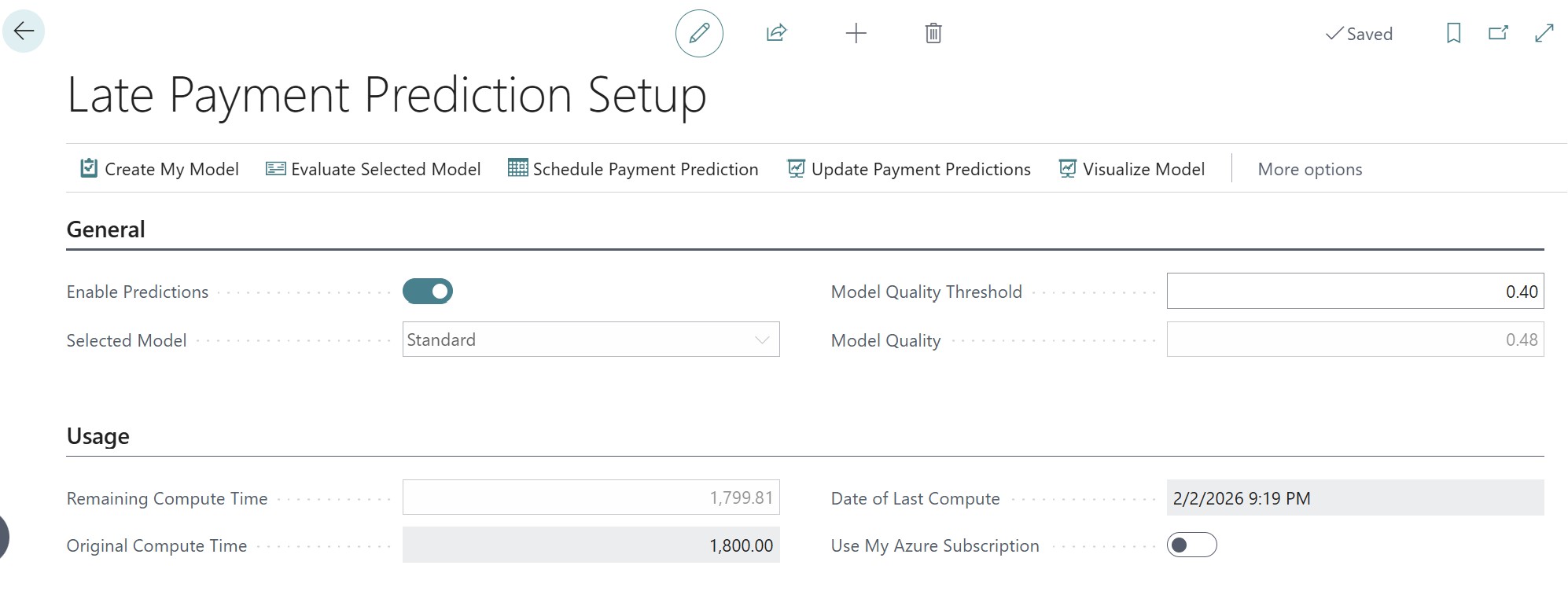
This feature relies on Azure Machine Learning, Microsoft's cloud service that analyzes massive volumes of data to spot typical behaviors and predict future results (here, the probability of delay). This statistical "brain" learns from your history to assign a reliability score to each invoice.
Model Operation: The model analyzes your billing history to identify behavioral patterns (amounts, usual lead times, payment days) specific to each customer. By crossing this data with statistical algorithms, it calculates a delay probability for each new invoice to anticipate payment defaults even before the due date.
Cost and Licensing: This service is included by default in your Business Central Essentials or Premium license. Microsoft offers a monthly free calculation time quota that is largely sufficient for the majority of SMEs. Only an industrial volume of transactions or the use of a custom model would require an additional Azure subscription.
The Azure ML Engine: To be effective, your database must have a history of at least 50 paid invoices.
Reliability Threshold: You can configure the "Late Payment Probability Threshold." For example, by setting this threshold to 80%, the IA will only display the risk alert if it is more than 80% certain that the delay will occur.
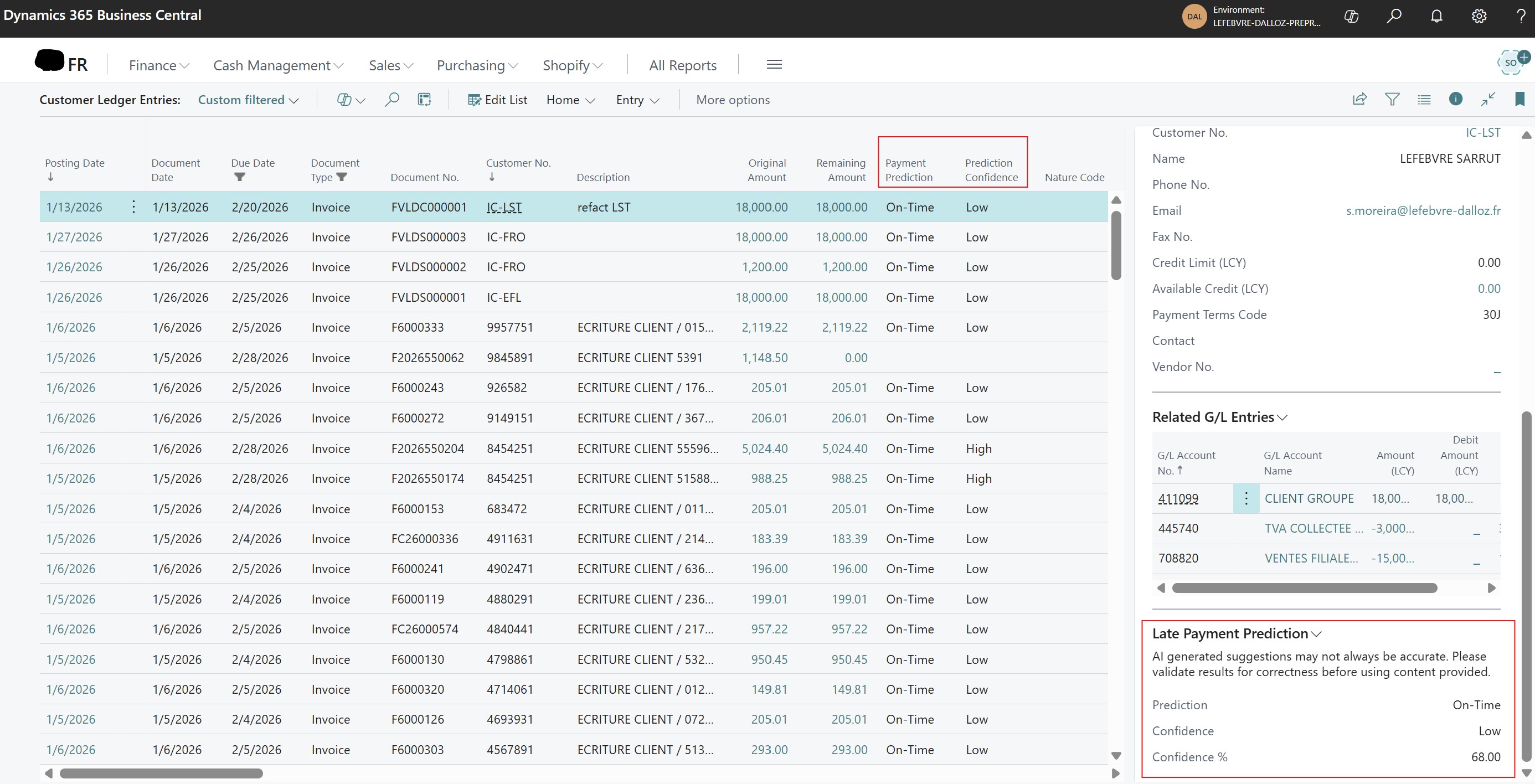
Visualization: The prediction appears directly on the customer ledger entries and in the dashboard as a risk score (Low, Medium, High).
Conclusion
Recognizing a loss is the ultimate step of controlled risk management. While Business Central offers tools to automate tax recovery, the accountant's responsibility remains total in gathering legal evidence. A well-documented file is the only guarantee against a tax adjustment on recovered VAT.
Useful links:
🇬🇧 https://learn.microsoft.com/en-us/dynamics365/business-central/ui-extensions-late-payment-prediction
🇬🇧 https://bondconsultingservices.com/business-central-late-payment-prediction-tool/
🇬🇧 https://www.loganconsulting.com/blog/easily-write-off-bad-debt-with-dynamics-365-for-finance/
🇬🇧 https://www.hubifi.com/blog/write-off-accounting-journal-entry







No comments yet.
Feel like commenting on this article? sign up, it's free!