









Mastering Customer Risk through the Accounting and Technical Guide under Microsoft Business Central
Index 
In a company's operating cycle, invoicing represents only a promise of future wealth. Between the issuance of the invoice and its effective collection lies a gray area in which credit risk can settle. This degradation process usually involves two phases: the transformation of the customer into a doubtful customer, then, in the event of definitive failure, the designation as an irrecoverable loss. This state of affairs implies a complex accounting and legal transition, transforming a current asset into a definitive loss. Writing off a customer as a loss consists of performing a necessary cleaning operation to ensure the sincerity of the balance sheet and the financial health of the organization.
The transition phase: The switch to doubtful customer
One must not confuse uncertainty and certainty. The accounting management of payment difficulties follows a precise gradation, dictated by the principle of prudence of the General Accounting Plan (PCG).
This principle requires marking receivables whose recovery becomes uncertain before recognizing a definitive loss. This is the switch to "doubtful customer."
The right timing
When a risk of non-recovery emerges, the accounting of a receivable must be adapted accordingly. Entry into "doubtful" status does not stem from a rigid deadline or a court order, but rather from the awareness of a real risk of non-recovery. Whether following unsuccessful reminders, a commercial dispute that drags on, or the opening of a safeguard procedure, accounting must reflect this vulnerability immediately. The objective is twofold: first, to isolate these compromised assets so as not to confuse them with healthy receivables, and, second, to prepare the ground for tax depreciation.
In this period of skepticism, accounting law requires the application of the precautionary principle. Even if the legal link with the customer is maintained and the receivable still appears as an asset on the balance sheet, it must nevertheless be "indexed" by a provision. The entry for an allowance or impairment thus allows for the recording of a potential charge in the income statement, without having to wait for the definitive loss. This measure remains reversible by nature. If the debtor's situation improves, or if a payment occurs, the provision is reversed by a reversal entry (Account 🇫🇷7817 🇬🇧8150 🇮🇹52.10.05), thus restoring the initially deducted value to the net result.
The accounting scheme
The switch to doubtful is a reclassification operation that does not modify the result, followed by a provision which, in turn, impacts the profit.
Step A : Reclassification of the receivable (Gross amount / Inc. VAT)
- Debit account 416 (🇫🇷416 🇬🇧1101 🇮🇹04.01.02 Allowance for Doubtful Account)
- Credit account 411 (🇫🇷411 🇬🇧1100 🇮🇹04.01.01 Accounts Receivable)
Step B : Recognition of the impairment (Net amount / Excl. VAT)
The provision is always calculated on the amount excluding taxes, because the company cannot provision for VAT that it has not yet definitively lost.
- Debit account 6817 (🇫🇷6817 🇬🇧8100 🇮🇹12.05.01 Bad Debt Expense account)
- Credit account 491 (🇫🇷491 🇬🇧1190 🇮🇹04.01.09 Provision for Doubtful Debts)
Implementation in Microsoft Business Central
In Business Central, there is no automatic transfer to an account 416 (🇫🇷416 🇬🇧1101 🇮🇹04.01.02 Allowance for Doubtful Account). The recommended procedure is as follows:
- Change of Customer Posting Group: You can create a customized "Customer Posting Group" called "DOUBTFUL", which will be linked to general ledger account 416 (🇫🇷416 🇬🇧1101 🇮🇹04.01.02 Allowance for Doubtful Account). By modifying the group on the reclassification entry, the receivable is moved accounting-wise.
- Entering the impairment: It is performed via a General Journal. The user enters a line debiting 6817 (🇫🇷6817 🇬🇧8100 🇮🇹12.05.01 Bad Debt Expense account) and crediting 491 (🇫🇷491 🇬🇧1190 🇮🇹04.01.09 Provision for Doubtful Debts).
- Traceability: It is advisable to use Dimensions to mark these entries, thus allowing for the generation of an aged trial balance specific only to doubtful customers.
However, the situation becomes more complicated if the invoice(s) for the doubtful receivable are subject to VAT on collection (UK VAT Cash Accounting Scheme, IT IVA per cassa, US Cash Basis (Sales Tax)). Further on, I will address this issue and show the best approach to adopt.
Setup
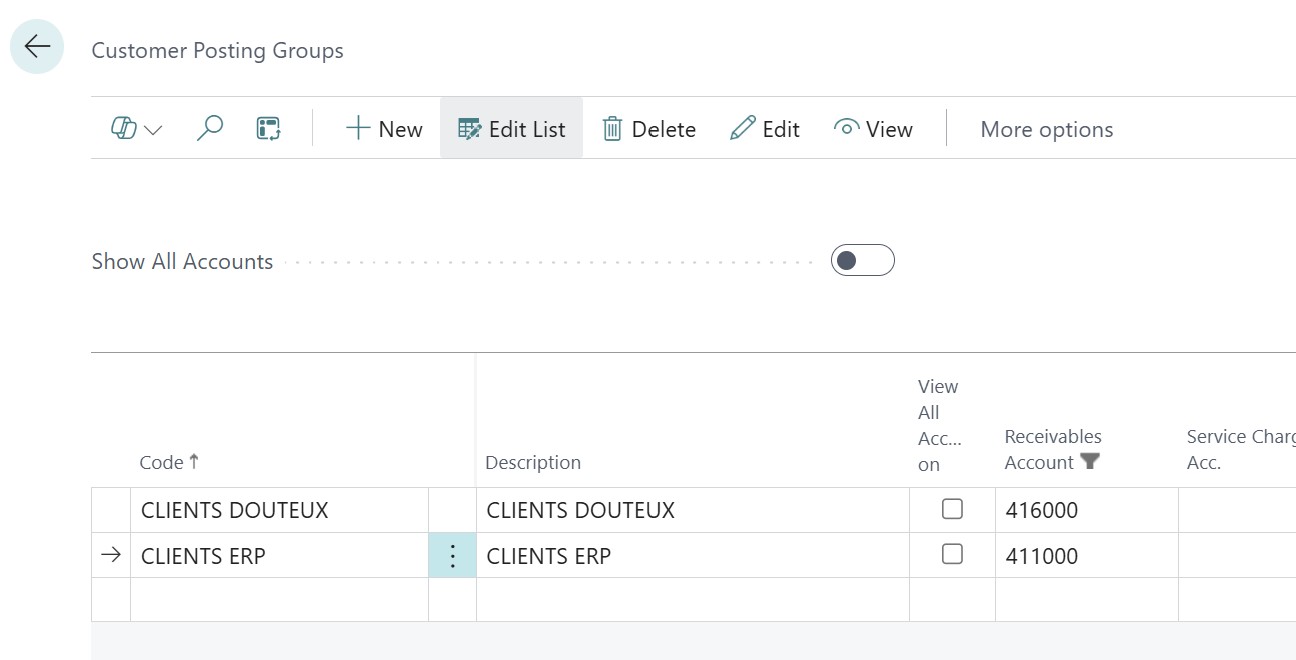
“Doubtful” customer posting group
The first setup step in Business Central to manage the risk of non-recovery is the creation of a specific Customer Posting Group. It is essential to create a new group named, for example, "DOUBTFUL". This new posting group must be associated with the general account 416 (🇫🇷416 🇬🇧1101 🇮🇹04.01.02 Allowance for Doubtful Account).
This configuration allows for easy and traceable reclassification of all uncertain receivables out of the healthy customer account (411(🇫🇷411 🇬🇧1100 🇮🇹04.01.01 Accounts Receivable)) to the specific tracking account (416, (🇫🇷416 🇬🇧1101 🇮🇹04.01.02 Allowance for Doubtful Account)), thus isolating the risk in the General Ledger.
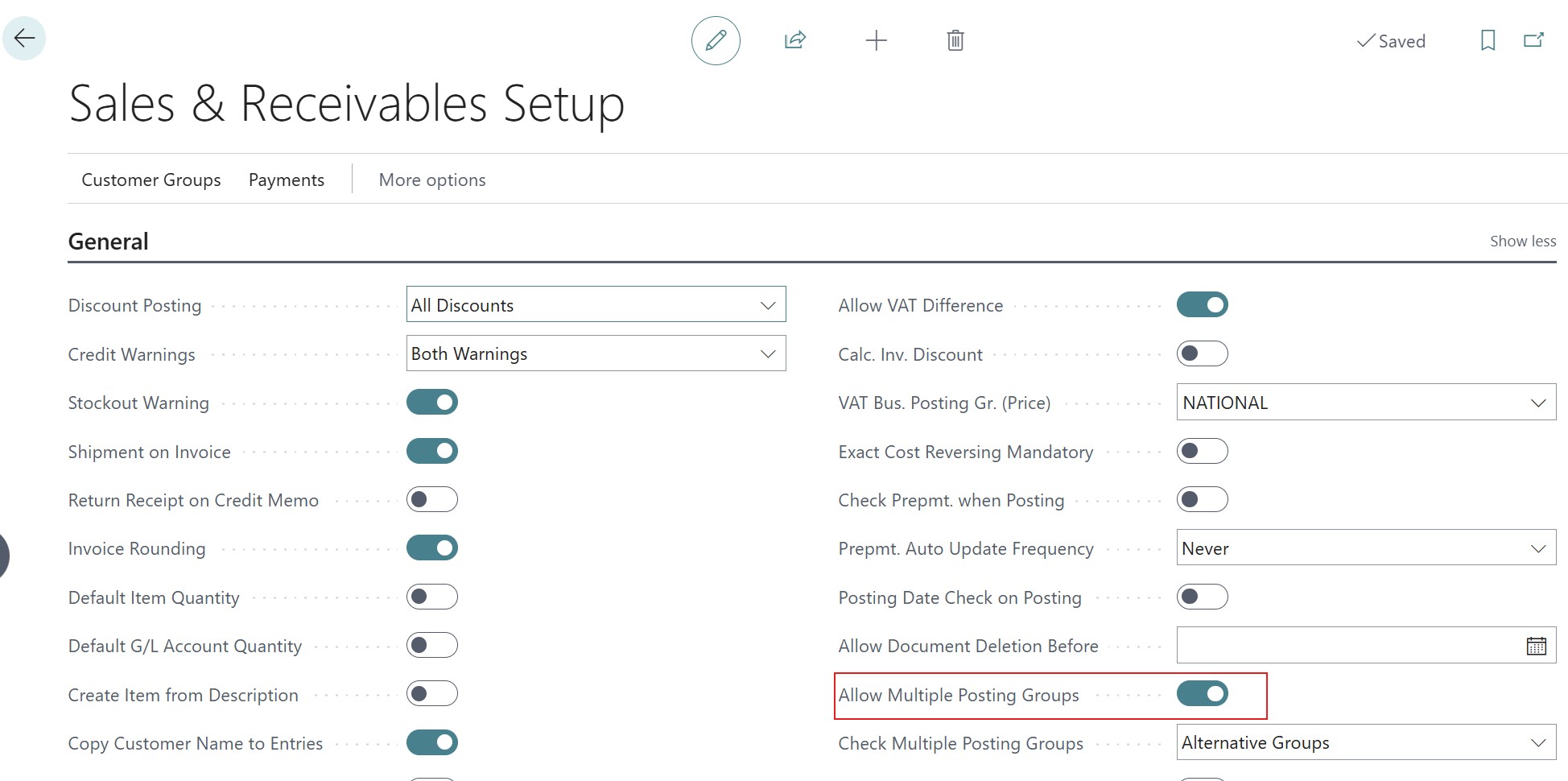
Allow multiple posting groups
The following setting, often referred to as authorizing "Alternative Posting Groups" or "Multi-posting groups," is crucial. It allows specifying that one wishes to be able to manage several customer posting groups for the same customer entity, and thus transition fluidly from one control account to another (for example, from 411(🇫🇷411 🇬🇧1100 🇮🇹04.01.01 Accounts Receivable) to 416 (🇫🇷416 🇬🇧1101 🇮🇹04.01.02 Allowance for Doubtful Account). This functionality ensures the flexibility necessary for reclassifying healthy receivables to doubtful receivables.
Multi posting groups
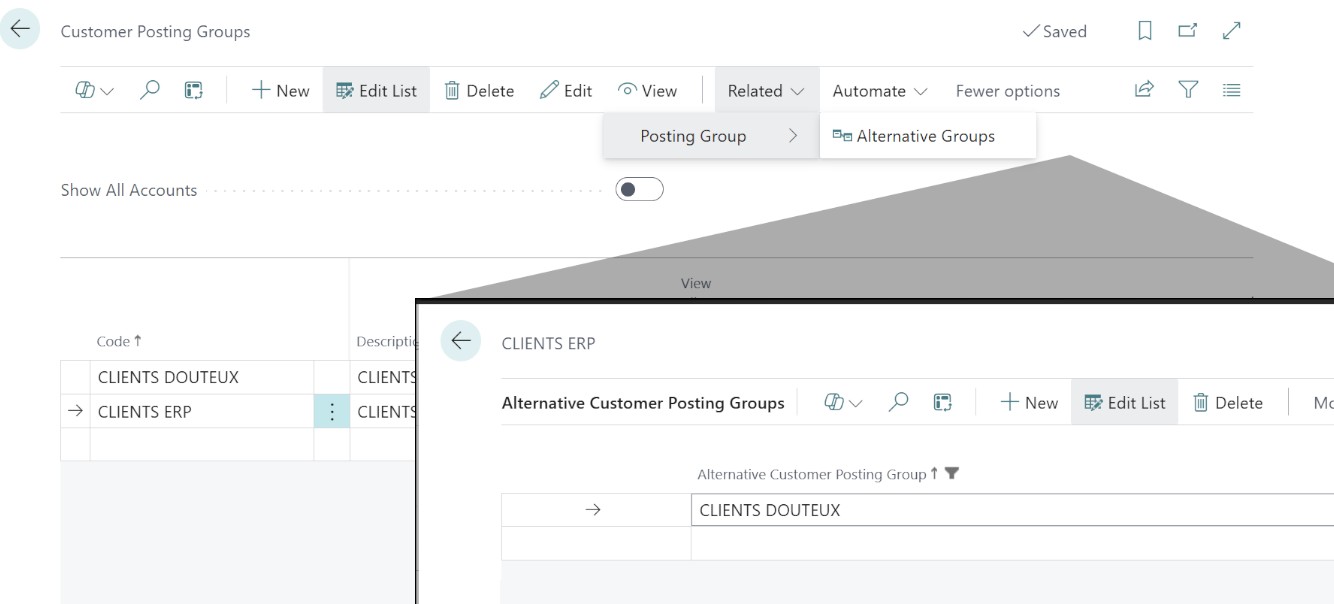
To ensure a smooth transition and to link the new "DOUBTFUL" group to the main group ("NATIONAL", "EXPORT", etc.), Business Central offers the possibility of authorizing alternative posting groups. In the card of the main posting group (e.g., "NATIONAL"), it is possible, via the "Alternative Groups" button, to designate "DOUBTFUL" as an authorized group.
This advanced configuration ensures that, even in the event of an entry error or during automated processes, the system recognizes the validity of the reclassification to the doubtful account, thus maintaining a clear audit trail between the initial customer account and its risk status.
Posting
The General Journal
The General Journal in Business Central is the preferred tool for recording reclassification and provision entries. It allows essential flexibility in managing doubtful receivables, particularly regarding Value Added Tax (VAT).
Since the initial switch of a healthy receivable (411(🇫🇷411 🇬🇧1100 🇮🇹04.01.01 Accounts Receivable)) to 416 doubtful (🇫🇷416 🇬🇧1101 🇮🇹04.01.02 Allowance for Doubtful Account) does not affect VAT, and particularly in the case of companies subject to VAT on collection (Cash Accounting), extra caution is required. The VAT collected on this receivable remains due to the State until the final loss is recorded or payment has taken place.
It will therefore be necessary to perform additional operations to reverse this VAT collected by the premature matching of the initial invoice and re-allocate it to the collection stage.
The General Journal mechanism will be used to:
Entries: without VAT on collection (Accrual Basis)
In the case of a sales invoice where VAT is due upon issuance (Standard VAT on debits), the reclassification of the customer receivable (411(🇫🇷411 🇬🇧1100 🇮🇹04.01.01 Accounts Receivable)) to the doubtful receivables account (🇫🇷416 🇬🇧1101 🇮🇹04.01.02 Allowance for Doubtful Account) is done directly. The operation does not lead to any immediate tax complications, since the VAT has already been declared and paid to the State at the time of invoicing. The impairment provision mechanism (Debit 6817(🇫🇷6817 🇬🇧8100 🇮🇹12.05.01 Bad Debt Expense account)/Credit 491(🇫🇷491 🇬🇧1190 🇮🇹04.01.09 Provision for Doubtful Debts)) is however required to anticipate the probable loss on the amount excluding taxes.
Take the case of this sales invoice:
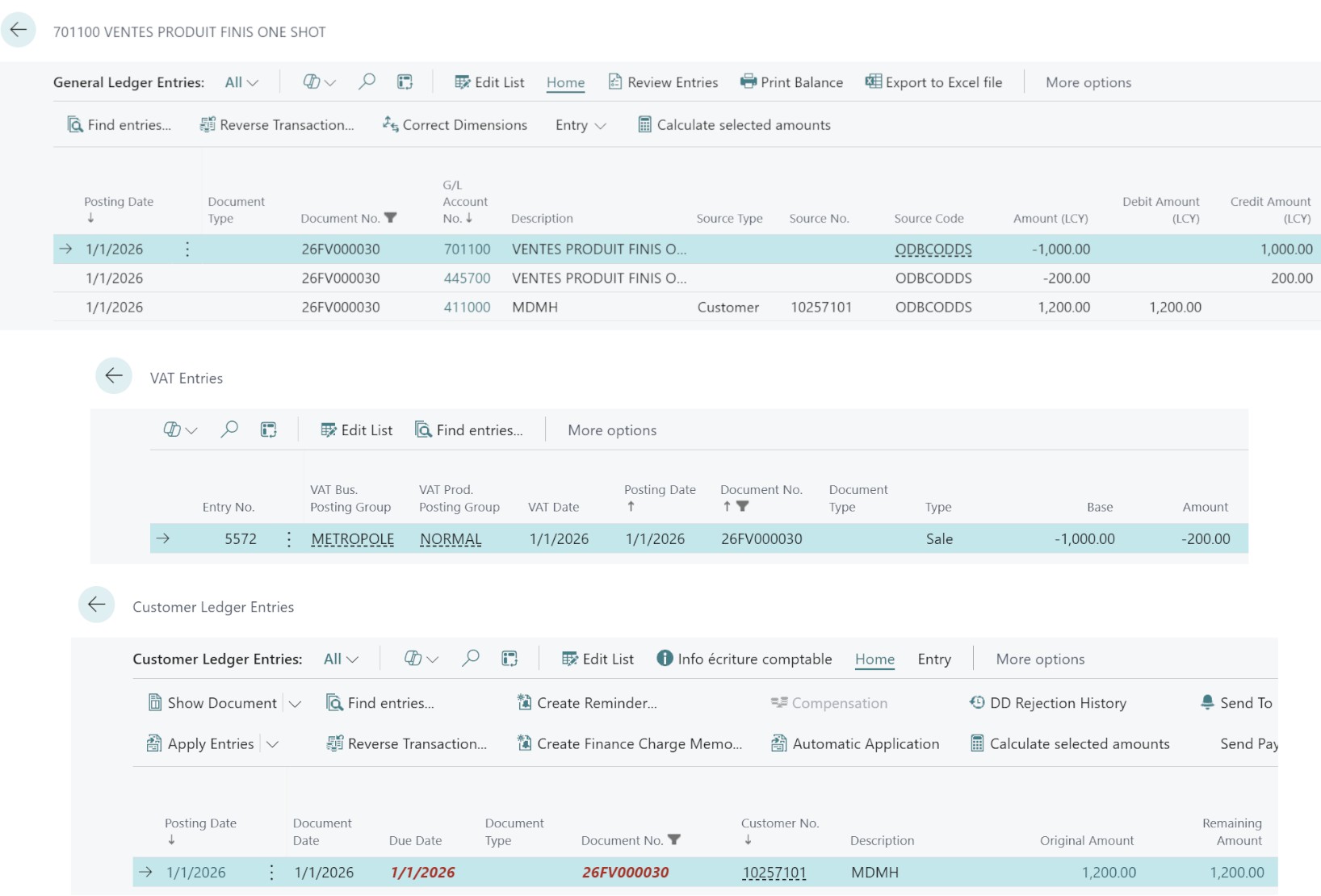
The entries to transfer the receivable from account 411(🇫🇷411 🇬🇧1100 🇮🇹04.01.01 Accounts Receivable) to 416 (🇫🇷416 🇬🇧1101 🇮🇹04.01.02 Allowance for Doubtful Account) are as follows:
Implementation in Business Central
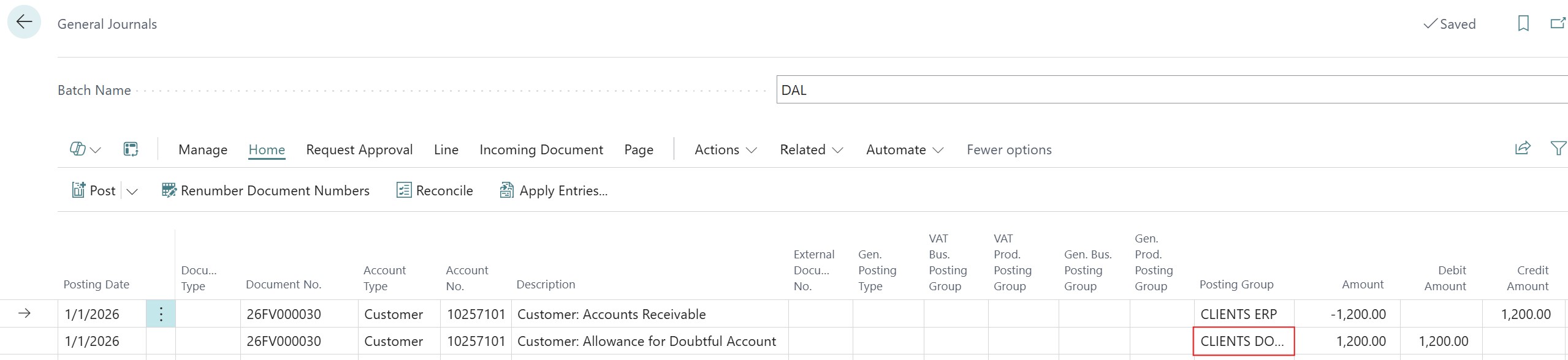
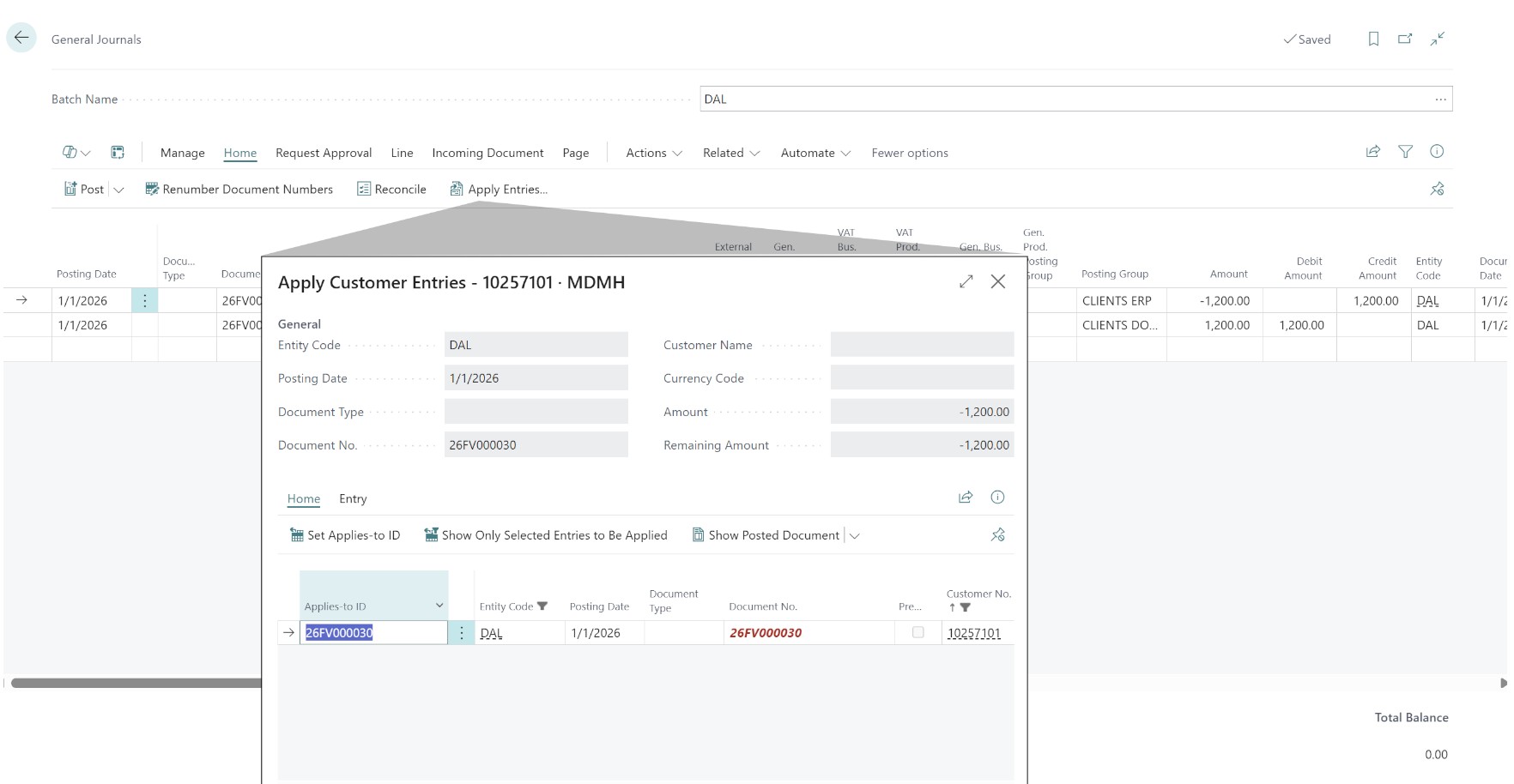
Do not forget to apply (match) the invoice on the first line; this allows closing the invoice and generating a new due date on the customer's position.
💡You should not specify a document type for this type of entry, and above all, do not forget to change the posting group to “Doubtful” on the second line, which will allow shifting the receivable from one account to the other.
After posting, the generated entries look like this:
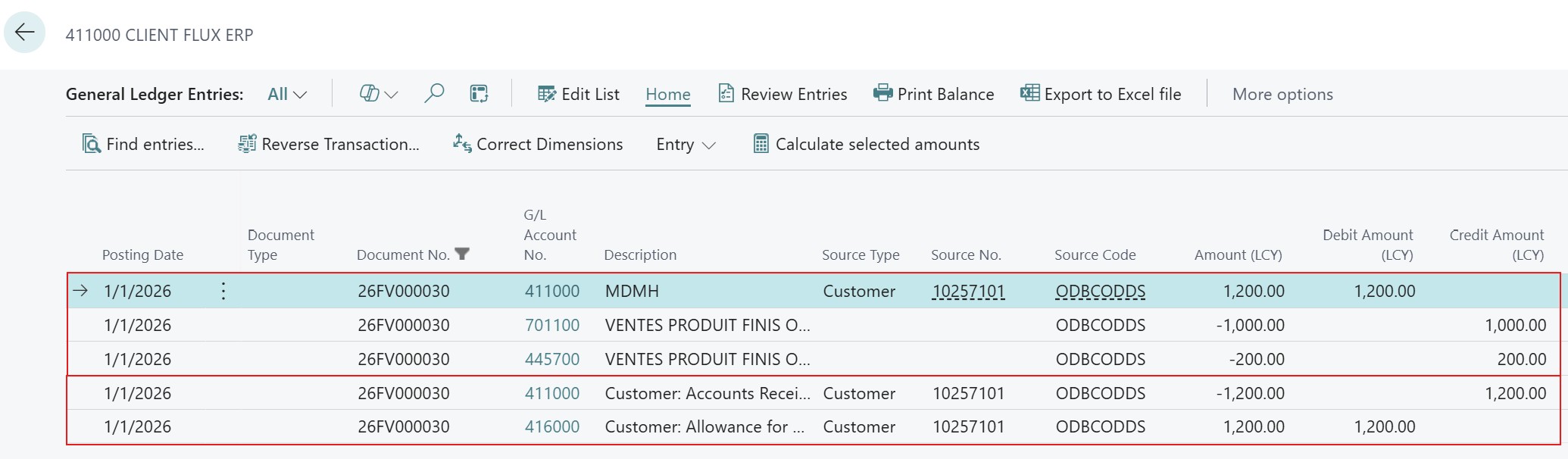
In the previous image, we can see the entries generated by the initial invoice that feeds account 411 (🇫🇷411 🇬🇧1100 🇮🇹04.01.01 Accounts Receivable), as well as the reallocation entries that transfer from 411 (🇫🇷411 🇬🇧1100 🇮🇹04.01.01 Accounts Receivable) in favor of 416 (🇫🇷416 🇬🇧1101 🇮🇹04.01.02 Allowance for Doubtful Account).
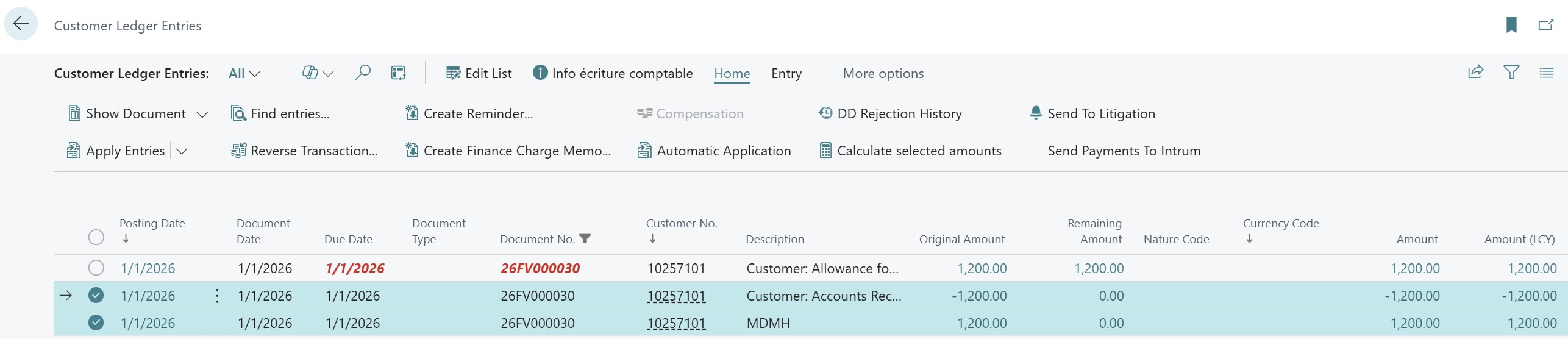
At the customer ledger entry level, we see that the original invoice was matched with the reclassification entry which created a new due date.

VAT entries have not changed; nothing was created on that side.
Entries: with VAT on collection (Cash Accounting)
In the case of a sales invoice subject to VAT on collection, the task is a bit more complex. The principle is to go through a suspense account on which we will generate the reversal of collected VAT due to the matching of the initial invoice, but also the VAT on collection to return the tax to the original state.
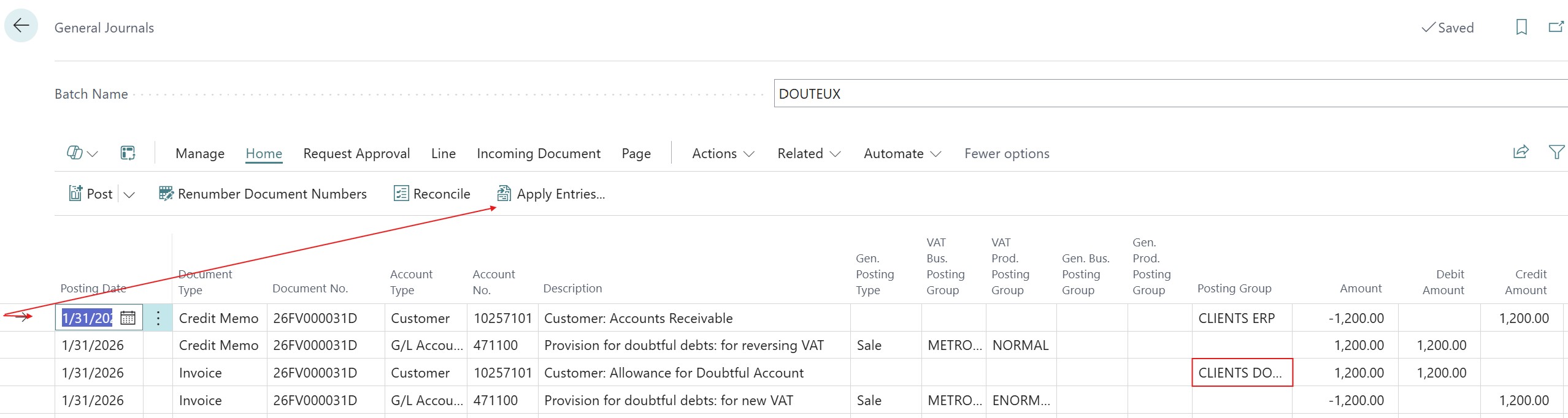
In summary, this sequence allows transferring the receivable from 411(🇫🇷411 🇬🇧1100 🇮🇹04.01.01 Accounts Receivable) to 416(🇫🇷416 🇬🇧1101 🇮🇹04.01.02 Allowance for Doubtful Account), while managing the complexity of VAT on collection so that no VAT is declared to the State before its payment or definitive loss.
Result of the accounting validation of this entry scheme:
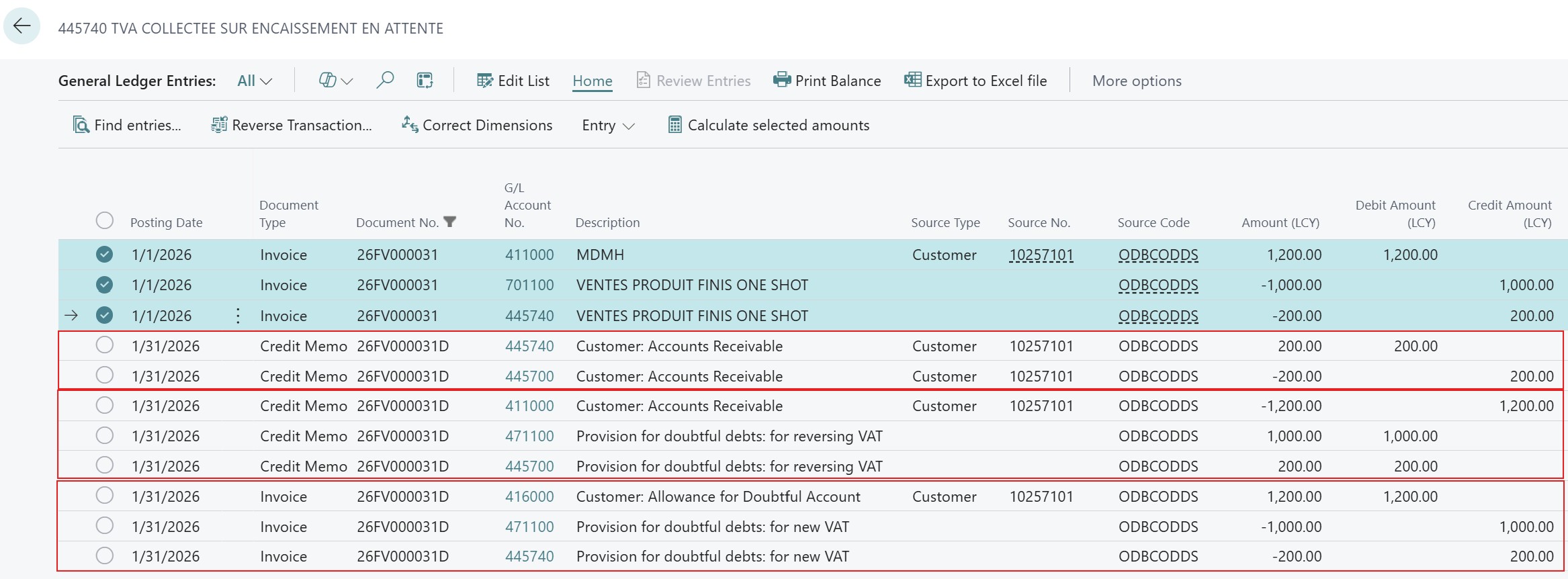
In the previous image:
- The first 3 lines correspond to the original invoice.
- The next two were generated by the matching of the credit note; the system collected the VAT on collection.
- The next three correspond to the credit note, thus reversing the customer receivables account 411(🇫🇷411 🇬🇧1100 🇮🇹04.01.01 Accounts Receivable), with the suspense account used to calculate VAT on debit as the counterpart, which cancels the VAT collected in the previous point.
- The last three report the customer receivable to the balance sheet but on account 416(🇫🇷416 🇬🇧1101 🇮🇹04.01.02 Allowance for Doubtful Account), clear the suspense account, and re-allocate the VAT on collection.
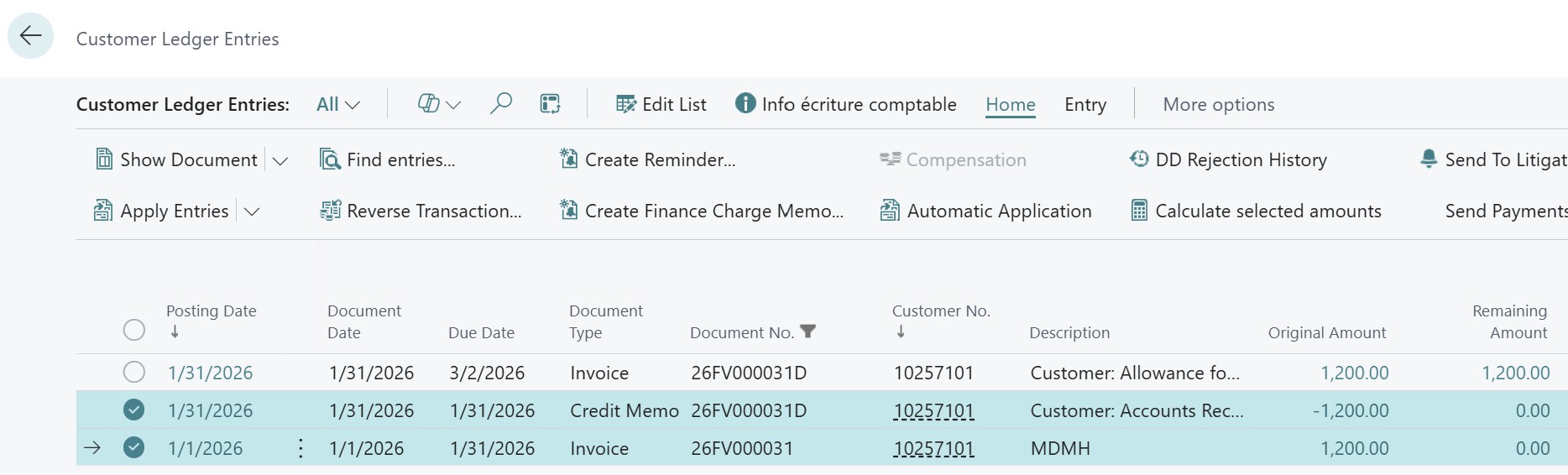
At the customer ledger entry level, we see the matching of the original invoice to the reclassification and the new uncollected due date.

Finally, examining the VAT entries, the first two lines correspond to the VAT on collection triggered by the matching of the credit note. The third line reverses this collected VAT and the last one returns the tax to its initial stage (to be collected).
Tax Anticipation: Impairment as a shield for results
As soon as the reclassification to account 1100 is performed, the prudence mechanism must be triggered without delay by recognizing the provision. If the transfer to doubtful customer legally isolates the receivable, it does not yet protect the company's results. This is where the duo of accounts 6817(🇫🇷6817 🇬🇧8100 🇮🇹12.05.01 Bad Debt Expense account) and 491(🇫🇷491 🇬🇧1190 🇮🇹04.01.09 Provision for Doubtful Debts) comes in, whose role is to immediately reflect the probable depletion of the asset. By acting without waiting, the accountant allows the company to benefit from an immediate tax reduction: the recorded charge decreases the taxable profit for the current financial year, thus offering a breath of fresh air in terms of cash flow (in the form of tax savings) to partially compensate for the lack of collection.
On a technical level, this accounting scheme unfolds with mathematical rigor: we debit account 6817(🇫🇷6817 🇬🇧8100 🇮🇹12.05.01 Bad Debt Expense account) to record the charge in the income statement, and we credit account 491 (🇫🇷491 🇬🇧1190 🇮🇹04.01.09 Provision for Doubtful Debts) in return. The latter acts as an asset valuation account. It sits "opposite" the doubtful receivable to reduce its net book value on the balance sheet.
💡It is crucial to emphasize that this provision is always calculated on the amount excluding taxes of the receivable: the company only depreciates its own share of income, VAT being a neutral tax that will be adjusted later with the State only if the loss becomes irrevocable.
[H3]Implementation in Business Central
Again, the General Journal is the most appropriate tool in Business Central to validate this kind of impairment entry.
The scheme is as follows:
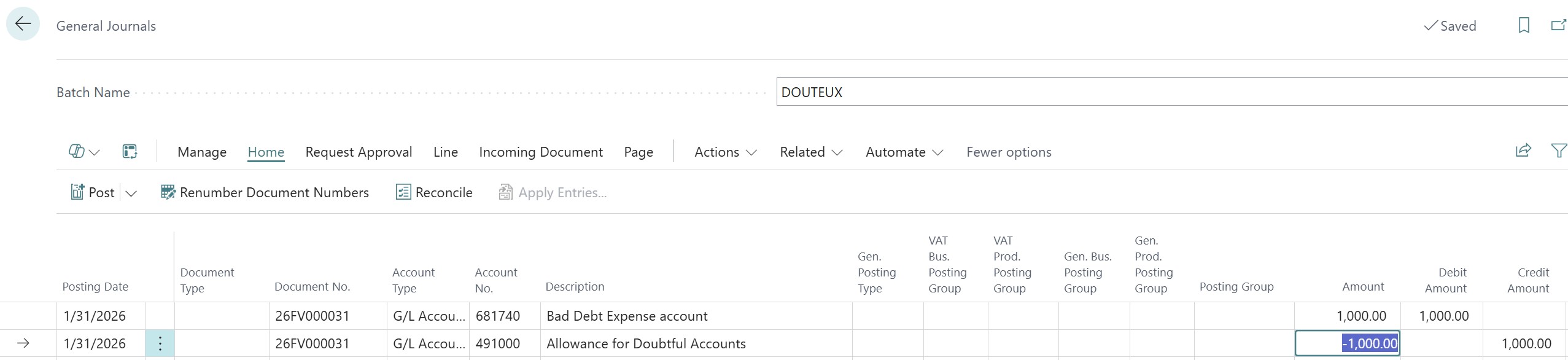
The posting will generate the accounting entries.
Conclusion
The life cycle of a difficult receivable, from the switch to doubtful to the irrecoverable loss (which we will see in the next article), requires perfect mastery of accounting flows and ERP tools. While Business Central ensures the precision of calculations and the recovery of VAT, it remains dependent on the accountant's rigor in matching and archiving legal evidence. Healthy management of doubtful receivables is not only a tax obligation; it is the guarantee of transparent financial information and a company capable of anticipating its risks.
Useful links:
🇬🇧 Allowance for Doubtful Accounts and Bad Debt Expenses
🇬🇧 Understanding, managing and accounting for bad debts






No comments yet.