










SWOT Analysis for IT Projects, From Diagnosis to Action Plan
Index 
SWOT analysis (Strengths, Weaknesses, Opportunities, Threats) is a strategic assessment tool. In the IT field, this method helps to structure the internal and external factors that determine the success of a digital transformation.
1. Why perform a SWOT analysis in computer science
Managing an IT project involves major investments and significant technical risks. Conducting a SWOT analysis primarily addresses the need to objectively assess risks by comparing technical constraints with available resources to identify vulnerabilities well before deployment. It also ensures strategic alignment between the targeted functionalities and the organization's actual maturity. Finally, this exercise secures architectural choices and vendor selection through a shared, comprehensive vision.
The history of IT projects is replete with cases where the absence of this initial assessment has proven costly. Consider the city of Portland, which, in the early 2010s, launched a complete overhaul of its information systems without having evaluated the technical maturity of its internal teams or the complexity of its legacy processes. The project was abandoned after swallowing tens of millions of dollars—a failure that could have been avoided if a thorough analysis of internal weaknesses and technical debt had been conducted from the outset.
2. When to initiate this process
The timing of the analysis directly determines its effectiveness. This study should be initiated at key moments in the project lifecycle.
The first opportunity for intervention occurs during the initial phase, such as the scoping or feasibility study, to validate overall feasibility before committing budgets. The second opportune moment arises when choosing an application solution or an ERP system, to objectively compare the organizational impact of the different options considered. Finally, the evaluation must be updated at major project milestones, particularly before moving to the detailed scoping phase or during a significant infrastructure change.
3. By whom should the analysis be conducted?
A SWOT analysis should never be written in isolation by a single person behind a desk. The success of the exercise depends on facilitating a group workshop that brings together key roles within the organization.
The project management team, represented by the IT project manager and the sponsor, ensures adherence to business objectives and the overall strategy. The technical teams, including architects and developers, provide essential insights into technical debt, security, and the feasibility of the integration. Meanwhile, business experts and key users identify the daily operational impacts and assess the actual level of buy-in to the change.
This diversity of viewpoints avoids the usual blind spots. It frequently happens during a workshop that a technical manager will describe data centralization as an absolute strength, while a subject matter expert in the room immediately points out that the Excel files used in the field are so chaotic that feeding this future system will represent a major weakness. It is precisely from this convergence of perspectives that the value of the approach arises.
4. How to conduct the step-by-step evaluation
Carrying out a SWOT analysis is based on a methodical three-step process.
The process begins with gathering internal information, creating a clear inventory of strengths, such as rare in-house skills or a robust infrastructure, and weaknesses, such as insufficient user training or accumulated application debt. This is followed by an analysis of the external environment to identify market opportunities, such as automation or new technologies, as well as threats, ranging from cyberattacks to unforeseen regulatory changes. The final step involves cross-referencing this data to develop a practical and operational action plan.
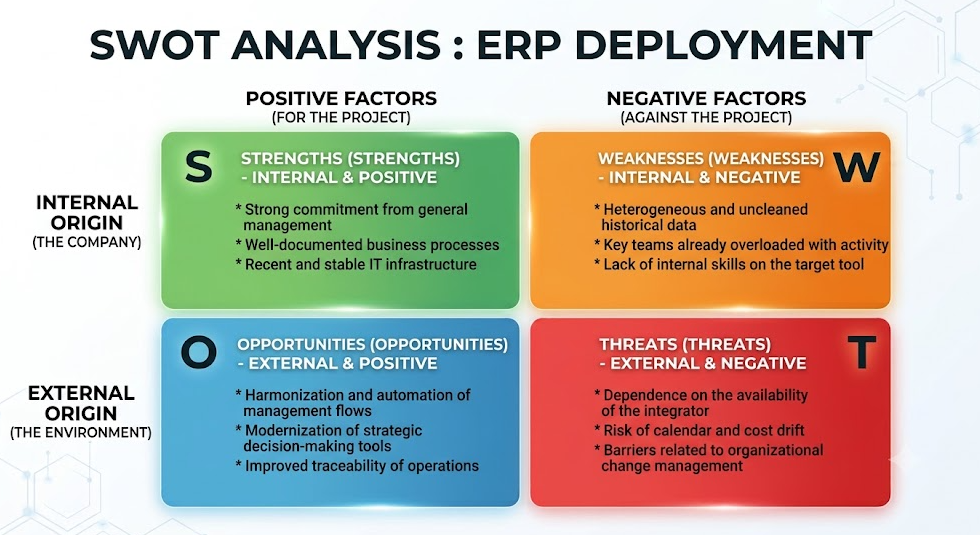
5. Concrete example of a SWOT matrix applied to an ERP project
5.1. Detailed analysis of the four quadrants
5.1.1. Internal Strengths and Supporting Factors
Positive internal factors form the basis for the project's success:
- Managerial support: An involved executive sponsor ensures rapid arbitration of critical decisions.
- Process maturity: The clarity of existing procedures simplifies the drafting of the specifications.
- Technical foundation: A compliant network architecture limits additional hardware investments.
5.1.2. Weaknesses, internal vigilance
Internal constraints necessitate prior corrective measures:
- Data quality: The presence of duplicates in the historical database necessitates a thorough cleaning project.
- Resource availability: The significant demand on subject matter experts may slow down the acceptance testing phases.
- Application support: The lack of technical mastery of the tool requires a reinforced training plan.
5.1.3. Opportunities, external benefits and targets
The project environment offers opportunities for modernization:
- Standardization: Adopting the publisher's best practices eliminates unnecessary custom development.
- Business intelligence: The integration of real-time dashboards improves the management of activities.
- Ecosystem support: Standardized add-on modules are available on the market.
5.1.4. Threats, external and environmental risks
External risk factors must be anticipated in the risk management plan:
- Provider failure: The strain on the market for specialist consultants can impact the quality of deliverables, particular attention is paid to the integration contract.
- Cost inflexibility: Underestimating the complexity of interfaces can lead to a reassessment of the budget.
- User inertia: Changes in work habits can generate blockages during deployment.
5.2. Use of the matrix in the action plan
The SWOT matrix becomes truly meaningful when factors are combined to build the project roadmap. From this perspective, the demonstrated maturity of internal processes is directly leveraged to accelerate the adoption of standard ERP functionalities. Simultaneously, to protect the project against the risk of schedule slippage, the anticipated workload of the business teams is offset from the initial phase by recruiting temporary reinforcements dedicated to user acceptance testing.
6. Conclusion
SWOT analysis is not merely a stylistic exercise when defining the scope of an IT project. When used appropriately, it constitutes a pragmatic tool for strategic alignment and risk management.
Its value lies in the collaborative approach it fosters, bringing together management, IT teams, and business experts around the same table. By objectively comparing internal realities with external constraints, the organization secures its technological choices, anticipates roadblocks, and transforms identified risks into concrete action plans. For a major project like the deployment of an ERP system, this pragmatic assessment is therefore a fundamental step toward the success of digital transformation.




No comments yet.